The shells desk
Open a drawer
Spherical geometry, two official tile counts, a song from the scaffolding, a fifteen-minute meeting, a state lottery, the Queen’s “wings or sails,” and a chicken in the orchestra pit.
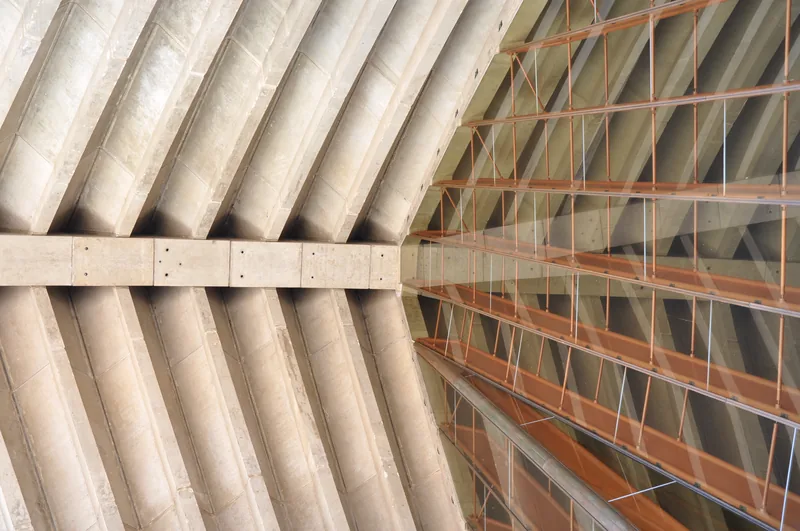
Open a drawer to look closer at the shells, a song on the scaffolding, a fifteen-minute meeting, a lottery, and a concert hall that has to stay at 22.5 degrees.
The shells came from a sphere
Between 1958 and 1962 the roof design “evolved through various iterations as Utzon and his team pursued parabolic, ellipsoid and finally spherical geometry.” Realising that the shells “could be derived from the surface of a sphere” meant the form could be prefabricated, and that a uniform tile pattern became possible. The official spherical-solution page calls that realisation “a milestone in 20th century architecture.” [source]
Two official ways of counting the tiles
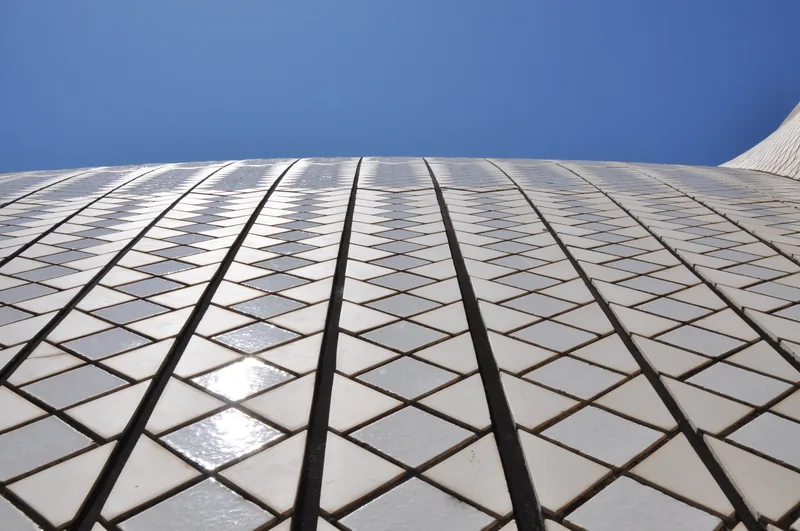
The interesting-facts page says: “There are more than 1 million roof tiles covering approximately 1.62 hectares sitting over the structure. They were made in Sweden.” The spherical-solution page gives an exact count: “In total, there are 1,056,006 tiles on the roof.” After “three years of work by Höganäs of Sweden,” the “Sydney Tile” was “120mm square, made from clay with a small percentage of crushed stone.” “The 4228 tile chevrons required to cover the shells were produced in a factory set up under the Monumental Steps.” Those two official counts are kept on their own lines. [source] [source]
The first performance was on the scaffolding
“Paul Robeson was the first person to perform at Sydney Opera House. In 1960, he climbed the scaffolding and sang Ol’ Man River to the construction workers as they ate lunch.” That 1960 lunchtime song is not the same event as the first staged production in 1973, when “the curtain in the Opera Hall rose on” Prokofiev’s War and Peace on 28 September, almost a month before the official opening. [source] [source]
Utzon walked out after barely fifteen minutes
“At noon on 28 February, 1966, Utzon met Davis Hughes at his Ministerial office in Bridge Street.” After a meeting of “barely 15 minutes,” Utzon walked out. “Hughes told the press that evening and then Parliament the next day that Utzon had resigned.” On 3 March, “1000 people marched on State Parliament through the streets of Sydney led by architect Harry Seidler, author Patrick White and others, who demanded that Utzon be reinstated.” [source]
The house cost far more than the first estimate
The facts page says: “The original cost estimate to build Sydney Opera House was $7 million. The final cost was $102 million and it was largely paid for by a State Lottery.” Other official pages give the early estimate as 3.5 million pounds. “Construction was expected to take four years. It took 14 years.” Those official figures are not converted into one another. [source] [source]
The Queen opened it on a blustery spring day
Queen Elizabeth II opened the house on 20 October 1973. “The Sydney Opera House has captured the imagination of the world, though I understand that its construction has not been totally without problems.” And: “The human spirit must sometimes take wings or sails and create something that is not just utilitarian or commonplace.” She has since visited four times, the facts page says, “most recently in 2006.” [source] [source]
A chicken walked off the stage
“A net was installed above the orchestra pit in the Joan Sutherland Theatre during the 1980s following an incident during the opera Boris Godunov. The opera featured live chickens and one bird walked off the stage and landed on top of a cellist.” The same official facts page notes that when the Sydney Symphony Orchestra is on stage in the Concert Hall, “the temperature must be 22.5 degrees to ensure the instruments stay in tune.” [source]
Keep exploring
Enjoyed the Opera House?
No pop-ups. No intrusive advertising. Just interesting stuff. A little support helps the next landmarks site get built.