Discoveries
Things you might not know about the Sydney Opera House
A song from the scaffolding, a chicken in the pit, a bodybuilding title in the Concert Hall, and a point that once had a tram depot.
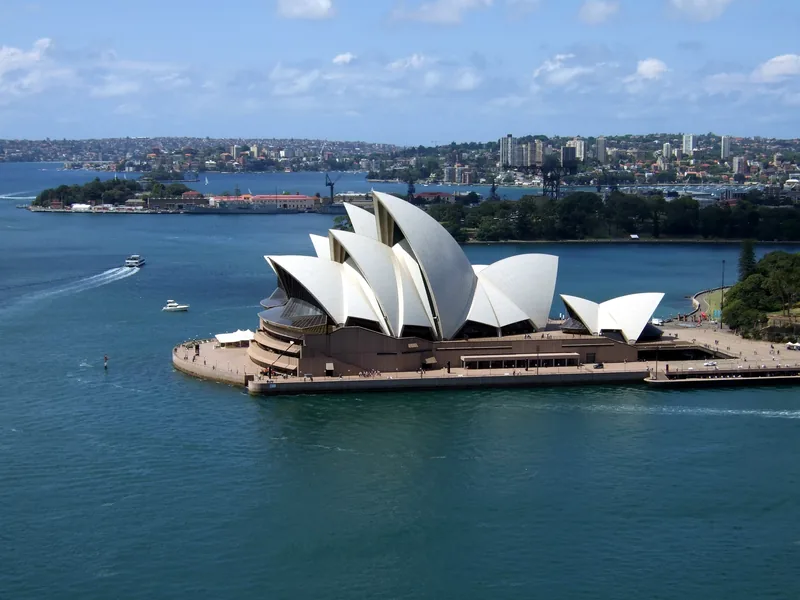
The first singer stood on the scaffolding
“Paul Robeson was the first person to perform at Sydney Opera House. In 1960, he climbed the scaffolding and sang Ol’ Man River to the construction workers as they ate lunch.” [source]
The shells came from a sphere
The roof design “evolved through various iterations as Utzon and his team pursued parabolic, ellipsoid and finally spherical geometry.” Deriving the shells from a sphere meant they could be prefabricated, and tiled in a uniform pattern. [source]
There are two official ways of counting the tiles
The facts page says “more than 1 million roof tiles covering approximately 1.62 hectares,” made in Sweden. The spherical-solution page says, exactly, “1,056,006 tiles on the roof,” in 4,228 chevrons, made after three years’ work by Höganäs of Sweden. [source] [source]
The chevrons were made under the steps
“The 4228 tile chevrons required to cover the shells were produced in a factory set up under the Monumental Steps.” Tiles were laid face down in one of 26 chevron-shaped beds, each curved to match the roof. [source]
Utzon wanted the roof to catch the sky
In his 2002 Design Principles he called the tiles “a major item in the building. It is important that such a large, white sculpture in the harbour setting catches and mirrors the sky with all its varied lights dawn to dusk, day to day, throughout the year.” [source]
A plaque is still in the steps
On 2 March 1959, in the rain, Premier Cahill screwed in a bronze plaque Utzon had brought, “at the point where the axes of the two halls would intersect,” and jackhammering began at once. “The plaque can still be seen on the steps today.” [source]
The beams under the steps were “Ove’s invention”
Single-span concrete beams, “some 49m long,” carry the Monumental Steps without a colonnade. Utzon “henceforth called them ‘Ove’s invention’,” after the engineer Ove Arup. [source]
Utzon left after barely fifteen minutes
At noon on 28 February 1966 he met the minister Davis Hughes in Bridge Street. After “barely 15 minutes,” he walked out. Hughes told the press that Utzon had resigned. On 3 March, a thousand people marched on State Parliament. [source]
A state lottery paid for most of it
The facts page gives an original estimate of $7 million and a final cost of $102 million, “largely paid for by a State Lottery.” It was expected to take four years, and took fourteen, with 10,000 construction workers. [source]
Seven A380s could sit wing-to-wing on the site
That comparison is on the official interesting-facts page, among the other figures. [source]
The Concert Hall is kept at 22.5 degrees
“When the Sydney Symphony Orchestra is on stage in the Concert Hall, the temperature must be 22.5 degrees to ensure the instruments stay in tune.” [source]
Mr Olympia was won here
“Arnold Schwarzenegger (former actor and Governor of California) won his final Mr Olympia body building title in 1980 in the Concert Hall.” [source]
A chicken landed on a cellist
A net was installed above the orchestra pit in the Joan Sutherland Theatre in the 1980s “following an incident during the opera Boris Godunov.” The production used live chickens, “and one bird walked off the stage and landed on top of a cellist.” [source]
The house is cooled with harbour water
“Sydney Opera House is cooled using seawater taken directly from the harbour.” The system “circulates cold water from the harbour through 35 kilometres of pipes.” [source]
Before the shells, the point had a tram depot
A 1940s photograph by Len Stone shows Bennelong Point with parkland and the Fort Macquarie tram depot. The official story of the point begins earlier still, with Tubowgule. [source]
Keep exploring
Enjoyed the Opera House?
No pop-ups. No intrusive advertising. Just interesting stuff. A little support helps the next landmarks site get built.